An illustration from an
Atlantic Bible, south French, late 11th century
Detail of Soldiers of Holofernes, Ms. Edili 125-126

Next: "Prologue to Jerimiah", Atlantic Bible, south French, late 11th century, Biblioteca Medicea-Laurenziana, Ms. Edili 125-126, f212r
Source: p7, French Medieval Armies 1000-1300 by David Nicolle (Author), Angus McBride (Illustrator)
'Guard playing a viol' Atlantic Bible, south French, late 11th century.
The most interesting piece of armour is this man's round topped one-piece helmet; these were seen in the Mediterranean lands, and probably reflected Byzantine influence.
(Ms. Edili 125-6, f.124v, Bib. Laurenziana, Florence).
Referenced on p153, Arms and Armour of the Crusading Era, 1050-1350, Western Europe and the Crusader States by David Nicolle.
288A-I The Atlantic Bible, southern France, late 11th century
(Biblioteca Medicea-Laurenziana, Ms. Edili 125-126, Florence, Italy)
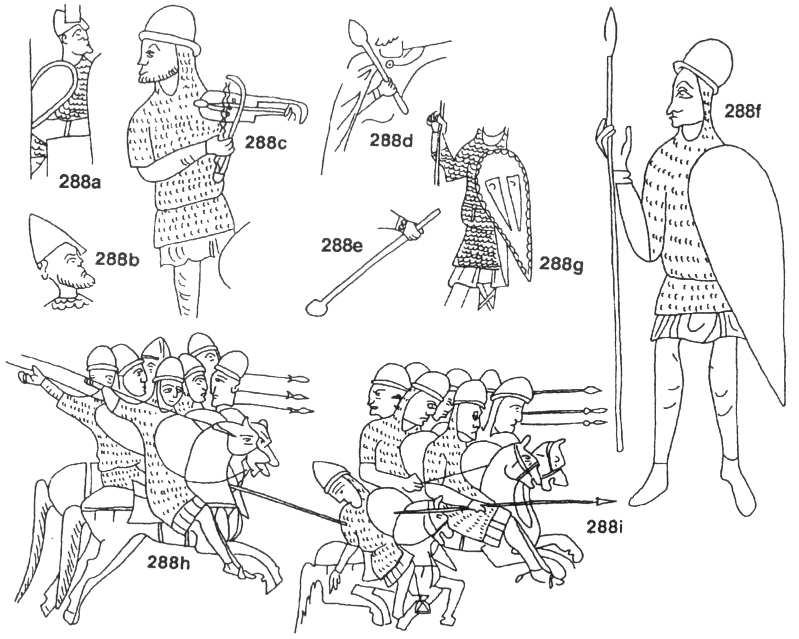
A - Expulsion of Moses' mother, f.27r; B - C - Soldiers of Holofernes, f.42v; D - f.212r; E - Expulsion of Moses' mother, f.27r; F - f.99r; G - f.88v; H-I - f.99r
Simple maces or clubs are illustrated twice in this manuscript (D and E).
Otherwise the military equipment is straightforward, consisting of spears, kite-shaped shields, and short-sleeved, short-hemmed mail hauberks.
One such hauberk has slightly longer sleeves (G) while others lack coifs (A, B, H and I).
None are shown with ventails across the face or hanging unlaced on the chest.
These hauberks do, in fact, seem to be of a simpler, earlier form than those illustrated in other late 11th-century southern French sources.
But the helmets are of basically the same variety as seen in various carvings.
These include round forms with rims but no nasals (C, F, H and I), slightly-pointed forms with rims but no nasals (H-I),
and tall conical types with integral nasals (A and B).
See also Norman, French, Breton and Anglo-Saxon Soldiers in the Bayeux Tapestry, c.1080AD, with captions in Latin & English
11th Century Illustrations of Costume & Soldiers
