The San Miguel Beatus Codex

Commentary on the Apocalypse by Beatus of Liébana, Spain, c.945AD
Pierpont Morgan Library, New York. Ms 644
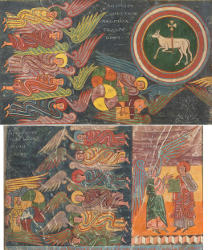


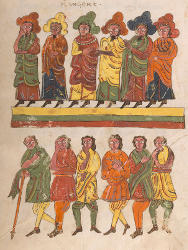
Shields

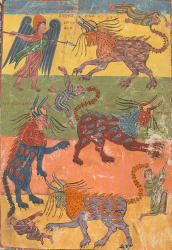
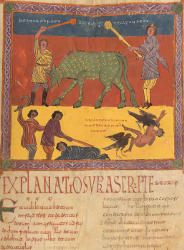
An Angel Attacks Locusts

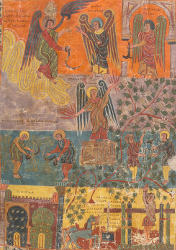
The death of the two witnesses

Harvest


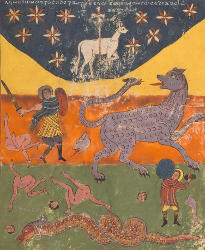
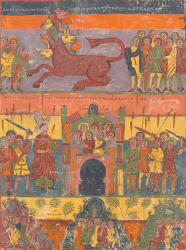
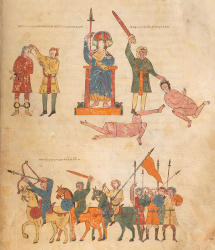
The victory of the Lamb over the kings

Kings and Merchants Mourn Babylon

The Beast and the False Prophet

The Antichrist


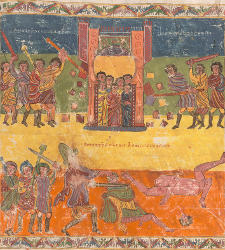
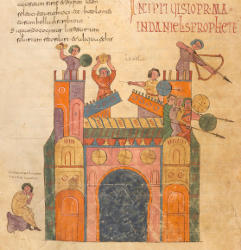
Jerusalem Besieged

Nebuchadnezzar's Army Besieges Jerusalem

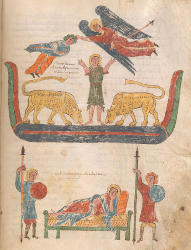
Daniel in the Lions' Den while Darius Lies Sleepless

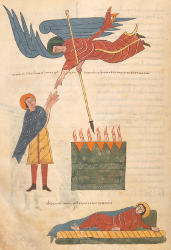
Gabriel interprets the vision to Daniel

Accession Number: MS M.644
Author/Artist: Beatus, Saint, Presbyter of Liebana, d. 798.
Uniform Title: In Apocalipsin
Title: Commentary on the Apocalypse (MS M.644).
Published/Created: Spain, perhaps in Ta´bara, ca. 940-945.
Description: 2 v. (149, 151 leaves (2 columns, 34-35 lines), bound : vellum, ill. ; 385 x 280 mm

Language: Latin
Script: Visigothic minuscule
Notes: Ms. written and illuminated in Spain, perhaps in Ta´bara, ca. 940-945.
  Texts: Beatus, Presbyter of Liebana, In Apocalipsin (fols. 1-233); Isidore of Seville, De adfinitatibus et gradibus (fols. 234-237); St. Jerome, Commentary on Daniel (fols. 238v-292v); an anonymous discussion of the Apocalypse and comments on Beatus’s work (fols. 294-299).
  Scribe: Maius.
  Decoration: 68 full-page miniatures, 48 smaller miniatures; diagrams, colored initials, and ornaments; Spanish Mozarabic style.
  Artist: Maius.

Executed for Abbot Victor of the Monastery of San Miguel de Escalada.
Source: The Morgan Library & Museum


We know it was produced by the archipictor Magius, commissioned by the abbot of the Leonese monastery of San Miguel de la Escalada. The author's name appears twice, once, in a long coda and then at the end of the text. Its datation is questioned as most authors place it in 922, but Camón Aznar suggests 958 and, according to John Williams, who in the last years has made a thorough study, it was written in 945. There is also a controversy about its scriptorium of origin. Initially it was believed that its origin was San Miguel de Escalada but it is more likely that it is Salvador de Tábara, as that was the place where Magius worked and was burried in 968.

This Beatus stayed in San Miguel de Escalada at least until the 14th century, in the hands of the Archbishop of Valencia, Martín Pérez de Ayala who, upon his death in 1566, donated the manuscript to the military order of Santiago in its master's residence of Uclés. It remained there until 1837, when the properties of the Church were confiscated in Spain. Around 1840, a merchant by the name of Roberto Frasineli handed it over to the manuscript collector Guillermo Libri Carucci, in exchange for an ancient silver clock. In 1852 he sold it to the Count of Ashburnham. In May 1897 it was acquired by the collector Henry Yates Thompson from London and on June 3rd 1919 it was acquired by the intermediary Quartich, for the Pierpont Morgan Library in New York.
Source: Turismo Prerrománico


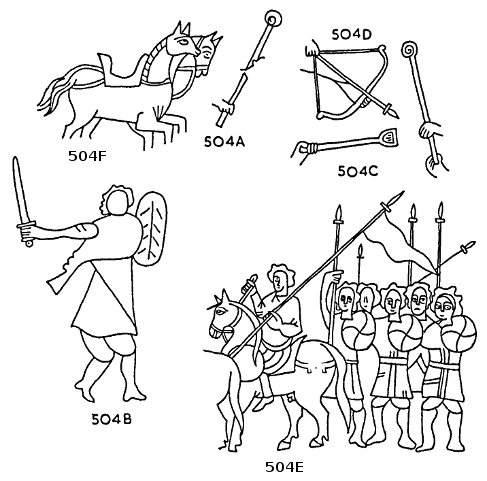
Referenced as figure 504 in The military technology of classical Islam by D Nicolle
504A to 504E. Manuscript, A - "Destruction of Jerusalem," B - "Victory of the Lamb," C - "Taking of the Beast," D - "Appolyon [Siege of Jerusalem]," E - "Army of Nebuchadnezzar," [F - "Harvest,] Beatus, 922-952 AD, Mozarab, Pierpont Morgan Lib., Ms. 644, ff. 151, 200, 211, 240v, 241 and 142v [178v], New York (Hof A).


Other copies of Commentary on the Apocalypse by Beatus of Liébana
Other 10th Century Illustrations of Costume & Soldiers


Free Web Hosting